



Prepare for Emergencies
With faculty and students who study hundreds of disciplines and thousands of subjects, Appalachian State University is certainly a diverse and vibrant campus. Unfortunately, recent surveys conducted by the Office of Environmental Health, Safety and Emergency Management indicate that many of our faculty, staff, and students are simply not prepared for one of the most fundamental and basic subject areas -- personal safety and preparedness.
Most people do not prepare for emergencies until they personally experience one. Preparing for emergencies, even the most basic, will help you respond quicker and more effectively should the need arise. If you would like to request a workshop or training in your department, contact the Office of Environmental Health, Safety and Emergency Management.
Each of the audience-specific pages below is specifically designed to provide you with a few of the most important things that you may do to prepare for emergencies. Please also familiarize yourself with the resources available throughout this site.
Emergencies
Learn how to prepare for and respond to specific emergencies.
Off-Campus Instructional Site Emergency Messaging
Some App State classes and activities may be offered at off-campus instructional sites where App State rents or uses space for learning or working, such as a community college campus. The off-campus instructional site bears the responsibility for managing emergencies and events in their location, and for alerting people on their property in the event of an emergency. App State recognizes the need to assist students, faculty and staff in finding where they can register for emergency alert messaging at off-campus instructional site locations. Please reach out to the safety office at safety@appstate.edu or (828) 262-4008 if you need assistance finding where to register for emergency alerts at these locations.
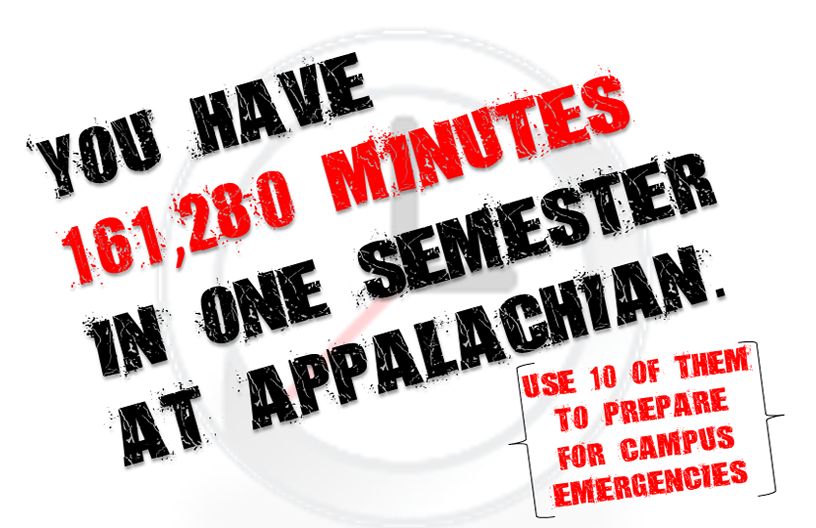
Take Ten Minutes to Prepare
We encourage all students to spend at least 10 minutes to better prepare yourselves for campus emergencies.
Take two minutes to register to receive emergency voice and text messages on your cell or smart phone through the AppState-ALERT system. Register for AppState-ALERT.
Next, take eight minutes to explore this emergency web site. The site has information for both students and parents.
Nearly every week, the media publishes reports about incidents on college campuses. From violence to hurricanes, we must all prepare ourselves to prevent, respond, and recover from emergencies and disasters. There are 161,280 minutes in an average semester; by spending ten of them preparing for potential emergencies, you to help make App State a safer and more resilient place to learn, live, work, and play. Print a copy of this emergency preparedness flier.
Emergency Numbers
- Fire, Police and Ambulance (EMERGENCY)
On-campus or off-campus: Dial 911 from any phone
- Appalachian Police Department
Emergency: 828-262-8000
Non-emergency: 828-262-2150
- Student Health Service (Boone and Hickory)
828-262-3100
- Catawba Valley Medical Center
828-326-3000
- Watauga Medical Center
828-262-4100
- Poison Control - Carolinas Medical Center
800-222-1222
Please note: Dial "2" plus the extention to dial any on-campus number from a campus landline phone in Boone
App State Is a "StormReady" Campus
Appalachian State University has completed a set of rigorous warning preparedness criteria established by the National Weather Service to earn the distinction of being a StormReady® University.
The Office of Environmental Health, Safety and Emergency Management (EHS&EM)
The emergency management program and emergency preparedness initiatives of Appalachian State University, including this web site, are now a service of the Office of Environmental Health, Safety and Emergency Management (EHS&EM). If you have any questions relating to EHS&EM programs at App State, please visit the EHS&EM site or the "Contact Us" section of this site.
No one knows if or when a disaster might disrupt campus operations. Recognizing the need to be prepared for any disaster--whether illness, blizzard, violent crime or another scenario—App State is always expanding and improving its campus-wide Emergency Operations Plan.
University leaders have taken steps to protect the safety and welfare of our students, faculty, staff, and campus visitors. They also have developed guidelines addressing the continuation of campus services should a disruption of services occur.